
How to Automate NGS Library Preparation: From Manual Protocol to a Validated Workflow
An evidence-based guide to mapping, automating, and validating NGS library preparation, with QC metrics, case studies, and instrument links.
NGS library preparation converts DNA or RNA into a library that is compatible with a sequencing platform. Depending on the assay, that work can include fragmentation or size selection, conversion to double-stranded DNA, adapter attachment, amplification, cleanup, and final quantification. Library quality can influence complexity, bias, batch effects, and the usefulness of the resulting sequence data (Head et al., 2014).
Automation can standardize repetitive liquid handling and reduce hands-on work, but it does not make a protocol valid simply because a robot can execute it. The chemistry, instrument configuration, labware, software method, sample type, and intended use form one implementation that must be evaluated together. Reviews of NGS automation therefore emphasize both the opportunity to reduce a multistep bottleneck and the need to match the automation strategy to throughput, flexibility, quality-control access, staffing, and cost (Hess et al., 2020; Socea et al., 2023).
Scope. This article is an implementation and validation guide, not a kit-specific standard operating procedure. Follow the current instructions for your exact library-preparation kit and instrument. Clinical or diagnostic use also requires validation under the rules that apply to your laboratory.
The five-part migration
- Define the intended use and the boundary of automation.
- Translate the current manual method into explicit machine instructions.
- Develop the liquid-handling and magnetic-bead operations on the chosen deck.
- Compare the automated method with the accepted manual method and test precision.
- Release the method only with documented acceptance criteria, controls, maintenance, and change control.
There is no universal minimum batch size, fixed validation duration, or default number of extra reactions that makes these steps succeed. Those values depend on the assay, risk, instrument, cost model, and laboratory requirements (Socea et al., 2023).
1. Define what the instrument will—and will not—do
Start with the exact kit version, sample types, input range, desired batch sizes, sequencing platform, and result that the workflow must support. Then decide which operations remain on the liquid handler and which require an off-deck instrument or a human transfer. NGS automation is not a single architecture: workstations differ in pipetting heads, magnets, grippers, shakers, temperature control, thermocyclers, readers, deck capacity, and software flexibility (Hess et al., 2020; Socea et al., 2023).
| Operation | When it can be automated | What must be verified |
|---|---|---|
| Reagent and sample transfer | The required volume range, labware, and liquid classes are supported | Accuracy, precision, carryover, source tracking, and dead volume |
| Mixing and master-mix distribution | The deck supports the required pipetting or shaking action | Homogeneity, foaming, settling, and time between wells |
| Magnetic-bead cleanup or size selection | A compatible magnet and controlled aspiration are available | Bead resuspension, separation time, pellet position, residual wash, and recovery |
| Incubation | The required temperature module and sealing strategy are available | Actual sample temperature, uniformity, condensation, and timing |
| PCR | An integrated thermocycler is available, or a documented off-deck transfer is acceptable | Plate sealing, pre-/post-PCR separation, transfer identity, and program version |
| QC and quantification | A reader is integrated, or the method defines an off-deck checkpoint | Sampling, data transfer, thresholds, and failed-sample handling |
| Normalization and pooling | Concentration data and pooling logic can be transferred reliably | Units, rounding, minimum transfer volume, traceability, and exception handling |
Do not label PCR or QC as inherently “manual.” They are automated on some systems and off-deck on others. Equally, an instrument with an optional module should not be described as having that function unless the module is actually installed and qualified.
2. Translate the manual protocol into a machine-readable method
A manual protocol often hides decisions inside phrases such as “mix thoroughly,” “wait until clear,” or “avoid disturbing the pellet.” A machine method must replace those judgments with explicit, testable parameters. Record at least the following for every step:
- reagent name, lot-sensitive requirements, storage condition, and working volume;
- source and destination labware, well geometry, and plate orientation;
- aspiration and dispense volume, height, speed, delays, and tip pre-wetting where applicable;
- mixing volume, speed, cycle count, and whether beads can settle while the plate waits;
- incubation setpoint, verified sample temperature, duration, lid or seal, and transfer time;
- magnet type, plate compatibility, separation endpoint, pellet location, and aspiration path;
- tip policy, pre-PCR and post-PCR segregation, and contamination controls;
- every manual intervention, safe stopping point, recovery action, and audit-log field.
Manufacturer instructions are the starting constraint, not a detail to retrofit later. For example, the current Illumina DNA Prep documentation instructs users to bring purification beads to room temperature, vortex to resuspend them, aspirate and dispense the viscous suspension slowly, wait for the liquid to clear on the magnet, remove residual ethanol, and use defined drying and resuspension steps (Illumina DNA Prep, document 1000000025416 v12). An automated method must reproduce the purpose of those operations without assuming that a manual gesture transfers directly to a robot.
Measure overage instead of copying a rule of thumb
Reagent overage must cover the aspiratable residual volume of the selected reservoir, pipetting behavior, and losses from the actual workflow. It is not safely defined by a universal fixed number of extra reactions. Meijers and colleagues used reagent excess equivalent to four samples in their particular eight-sample automated method, while the Illumina DNA Prep manual specifies a 20% overage when preparing ethanol for its cleanup step. Both are implementation-specific examples, not general defaults (Meijers et al., 2024; Illumina DNA Prep v12).
3. Treat magnetic-bead operations as a controlled process
Solid-phase reversible immobilization (SPRI) was originally described as reversible DNA binding to carboxylated magnetic particles in the presence of polyethylene glycol and salt, using a 96-well PCR-product purification method designed to be compatible with automation (DeAngelis et al., 1995). That foundational paper does not establish a universal bead ratio, fragment-size cutoff, drying time, or adapter-dimer removal rule for modern NGS kits.
For the exact kit in use, develop and verify:
- how beads are returned to a uniform suspension before and during dispensing;
- the bead-to-sample ratio and order of addition specified by the method;
- mixing that achieves recovery without excessive foaming or aerosol generation;
- separation time and the criterion used to decide that the supernatant is clear;
- aspiration height and path that remove supernatant without collecting the pellet;
- complete removal of residual wash solution without overdrying the beads;
- complete elution and resuspension before the next transfer.
These variables interact. Low library yield, for example, may reflect input quality, enzyme performance, transfer loss, residual ethanol, overdrying, or incomplete elution rather than one universal “bead problem.” Illumina specifically warns that residual ethanol can affect assay performance and that bead pellets should not be overdried or disturbed during wash steps (Illumina DNA Prep v12).
Adapter dimers also have multiple possible causes. They contain complete adapter sequences without the intended insert and can consume sequencing reads because they cluster on the flow cell. Illumina lists low or poor-quality input and inefficient bead cleanup among the causes and describes an unexpected peak around 120–170 bp as a common sign; the corrective action must still follow the exact library kit and sequencing platform (Illumina Knowledge Article #1911).
4. Design the validation before running the comparison
Define acceptance criteria before looking at the automated results. The study design should reflect the intended sample types and result, not a fixed internet checklist. Socea and colleagues distinguish accuracy, repeatability, reproducibility, analytical sensitivity and specificity, method comparison, and the reportable endpoint; they also state that sample numbers for precision should be determined and approved within the individual laboratory’s validation framework (Socea et al., 2023).
A defensible comparison usually includes:
- Method comparison. Prepare matched material with the accepted manual and candidate automated methods. Keep input material, reagent lots, and downstream sequencing conditions aligned where feasible.
- Repeatability. Repeat samples within a run to measure variation under the same conditions.
- Reproducibility. Repeat across relevant days, operators, instruments, reagent lots, or runs.
- Range and challenge samples. Represent the input range, sample matrices, quality states, and difficult conditions that the intended use actually permits.
- Contamination controls. Place negative controls and informative positives so that carryover and sample swaps can be detected.
- Failure handling. Test interruptions, unavailable modules, insufficient volume, failed QC, and any approved recovery or safe-stop procedure.
Select metrics that connect the library to the final result
| Stage | Candidate metrics | What they can reveal |
|---|---|---|
| Input | Concentration, integrity or fragment state, purity where relevant, positive and negative controls | Whether the compared material is within the intended range |
| Prepared library | Concentration or yield, fragment-size distribution, adapter-dimer fraction, control recovery | Transfer loss, fragmentation or cleanup differences, and suitability for sequencing |
| Sequencing | Reads passing filter, Q30 or platform-equivalent quality, mapping or assembly metrics, coverage and uniformity, duplicate rate or complexity | Whether library differences affect usable sequence data |
| Assay endpoint | Variant, expression, taxonomic, cgMLST, or other prespecified concordance measure | Whether the result used for interpretation remains acceptable |
| Process | Hands-on time, turnaround time, manual interventions, errors, failed runs, reagent and consumable use | The operational effect of this specific implementation |
No single metric proves equivalence. Library concentration can look acceptable while fragment distribution, contamination, coverage, or the assay-specific endpoint fails. Head and colleagues discuss how library construction can introduce bias, reduce complexity, and create batch effects, while Socea and colleagues show why QC checkpoints and result-specific criteria must be chosen for the intended assay (Head et al., 2014; Socea et al., 2023).
What published comparisons do—and do not—show
Published studies are useful examples of study design. They are not substitutes for validating a different kit, instrument, sample type, or result.
Bacterial whole-genome sequencing: Illumina DNA Prep on flowbot ONE
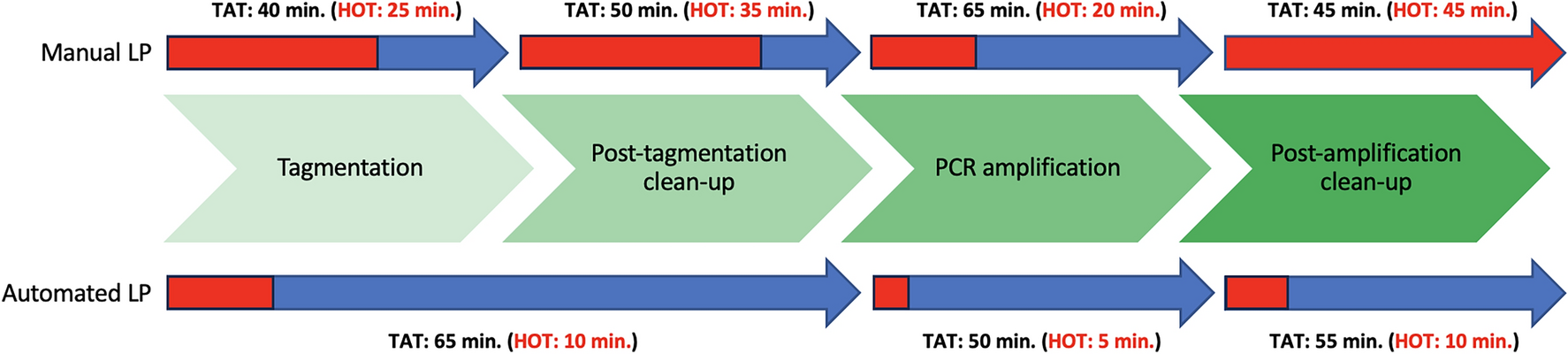
Meijers and colleagues prepared 16 bacterial DNA extracts with both manual and automated Illumina DNA Prep workflows. Eight of those extracts were processed again in an independent automated run. The automated method used a specific flowbot ONE deck with pipetting, heating/cooling, and magnetic hardware; PCR tube strips were transferred to an off-deck thermocycler, and indexes were added manually (Meijers et al., 2024).

The study reported a median 1.5-fold difference in library DNA concentration between the manual and automated methods, but the values were not identical: one Klebsiella pneumoniae library measured 10.9 ng/µL manually and 1.9 ng/µL after automation. After sequencing and normalization to one million reads per library, assembly metrics were similar. Among the 14 strains for which a species-specific cgMLST scheme was available, the complex types were 100% concordant; the remaining two strains did not have an applicable scheme (Meijers et al., 2024).
For batches of eight in that configuration, hands-on time was 25 minutes for the automated workflow and 125 minutes for the manual workflow. Turnaround time was 170 and 200 minutes, respectively. This is an 80% reduction in hands-on time but a 15% reduction in total turnaround time for that study setup—not a universal fivefold acceleration of NGS library preparation (Meijers et al., 2024).
mRNA-seq: NEBNext Ultra II Directional RNA on Biomek i7
Santacruz and colleagues compared manual and automated libraries from 84 RNA samples derived from two human cell lines, using the NEBNext Ultra II Directional RNA kit and a Biomek i7. They reported closely correlated expression profiles. The automated method replaced a two-day, approximately 12-hour manual protocol with a nine-hour hands-free instrument run after about two hours of reagent preparation. Those results apply to the study’s 250 ng RNA input, cell-line samples, kit, and workstation; they do not establish performance for degraded, low-input, clinical, or other RNA samples (Santacruz et al., 2022; 2024 corrigendum).
Troubleshoot from observations, not a single presumed cause
| Observation | Plausible contributors to investigate | Evidence to collect |
|---|---|---|
| Low or variable library yield | Input quality, liquid-transfer recovery, bead settling, residual wash, overdrying, incomplete elution, enzyme exposure | Input and post-library quantification, position map, liquid-level logs, fragment trace, controls |
| Shifted or broad fragment distribution | Fragmentation timing, temperature, bead ratio, mixing, magnet recovery, or sample quality | Fragment traces by plate position and run, module verification, method logs |
| Adapter-dimer peak | Input quantity or quality, adapter-to-insert balance, or cleanup performance | Input measurements, electropherogram, reagent version, cleanup records |
| Position-dependent results | Evaporation, timing across the plate, temperature distribution, sealing, or deck geometry | Well-level heat map, timestamps, environmental and module records |
| Cross-contamination or sample mismatch | Aerosols, tip policy, splash, deck order, plate orientation, or data-transfer error | Negative controls, distinctive positives, sample map, barcode and audit logs |
| Run-to-run drift | Calibration, maintenance, reagent lot, bead suspension, software or script change | Control charts, lot records, calibration status, version history |
More than one factor may produce the same symptom. Change one justified parameter at a time, preserve the failed-run evidence, and repeat the relevant comparison rather than declaring that “automation does not work.” Routine calibration, maintenance, staff competency, QC monitoring, and a controlled process for script changes remain necessary after the initial release (Socea et al., 2023).
Instrument links: evaluate the method, not only the deck size
The Pize NGS library-preparation application page lists three related automated sample-preparation systems. The descriptions below summarize the current Pize catalog; they are not independent validation data and do not establish compatibility with a particular kit.
| Catalog page | What the current page states | What to confirm before selection |
|---|---|---|
| iLab-100R | Compact 12-position system with interchangeable 1–32-channel pipetting; magnetic, thermal, PCR, quantification, and vacuum-filtration functions are optional | Exact kit method, installed modules, magnet/plate compatibility, minimum volume, and batch capacity |
| iLab-200R | 30-position system for larger batches with interchangeable 1–32-channel pipetting; magnetic, thermal, PCR, and quantification functions are optional | Whether the complete method fits one deck layout and which interventions remain off-deck |
| iLab-300R | 30-position high-throughput system; the page states one-pass NGS library construction for 96 samples or magnetic-bead purification for 384 samples, with optional 96/384-channel and process modules | Kit-specific performance data, actual installed configuration, validated batch size, controls, service, and change support |
Do not read “30 positions” as “30 samples,” treat optional modules as standard, or turn the iLab-300R’s 384-sample bead-purification statement into a claim of 384-sample NGS library preparation. Ask for the exact script version, deck map, labware list, validated input range, QC data, remaining manual steps, support arrangement, and change-control process. The wider AMTK catalog page is useful for browsing, but a catalog listing does not demonstrate a partnership, regulatory status, or fitness for an individual laboratory.
After sequencing: keep wet-lab and analysis validation separate
Pize is an AI coding assistant for scientific computing and statistical analysis. It runs in Pize Code and Positron, and also ships as an SDK. This software role is separate from the liquid-handler method: Pize should not be described as controlling, qualifying, or integrating the instruments listed above. Any downstream analysis workflow must be documented and validated for its own intended use, just as the wet-lab workflow is.
Frequently asked questions
How many samples make automation worthwhile?
There is no universal threshold. Compare current hands-on time, batch frequency, repeat rate, staffing constraints, reagent and disposable use, maintenance, instrument utilization, and validation effort. A low-volume laboratory may value rapid small batches; a high-volume laboratory may prioritize capacity. The appropriate balance depends on the workflow (Socea et al., 2023).
Can an Illumina or NEB kit be automated directly?
Only when a method exists for the exact kit and version, instrument configuration, labware, and modules—or when the laboratory develops and validates such a method. A protocol that works on one robot is evidence for that implementation, not a transferable guarantee for another platform (Hess et al., 2020).
How long should validation take?
No scientifically defensible fixed duration applies to every laboratory. Time depends on intended use, regulatory burden, sample diversity, acceptance criteria, availability of paired material, number of precision conditions, failure investigations, and whether the method or hardware changes during the study (Socea et al., 2023).
Should automated and manual libraries have identical yield?
Not necessarily. The question is whether predefined differences are acceptable across library QC, sequencing QC, and the assay-specific endpoint. The Meijers study reported generally comparable results but also a clear concentration outlier, which is why endpoint-level comparison is more informative than claiming identical yield (Meijers et al., 2024).
Does “walk-away” mean no human work?
No. Setup, reagent preparation, loading, off-deck transfers, QC, recovery, and review may remain manual. In the two studies discussed above, the flowbot ONE method required off-deck PCR handling and manual index addition, while the Biomek i7 method required approximately two hours of reagent preparation before the nine-hour instrument run (Meijers et al., 2024; Santacruz et al., 2022).
References
- Head SR, Komori HK, LaMere SA, Whisenant T, Van Nieuwerburgh F, Salomon DR, Ordoukhanian P. Library construction for next-generation sequencing: overviews and challenges. BioTechniques. 2014;56(2):61–77. doi:10.2144/000114133.
- Hess JF, Kohl TA, Kotrová M, Rönsch K, Paprotka T, Mohr V, Hutzenlaub T, Brüggemann M, Zengerle R, Niemann S, Paust N. Library preparation for next generation sequencing: A review of automation strategies. Biotechnology Advances. 2020;41:107537. doi:10.1016/j.biotechadv.2020.107537.
- Socea JN, Stone VN, Qian X, Gibbs PL, Levinson KJ. Implementing laboratory automation for next-generation sequencing: benefits and challenges for library preparation. Frontiers in Public Health. 2023;11:1195581. doi:10.3389/fpubh.2023.1195581.
- Meijers E, Verhees FB, Heemskerk D, Wessels E, Claas ECJ, Boers SA. Automating the Illumina DNA library preparation kit for whole genome sequencing applications on the flowbot ONE liquid handler robot. Scientific Reports. 2024;14:8159. doi:10.1038/s41598-024-58963-2.
- Santacruz D, Enane FO, Fundel-Clemens K, Giner M, Wolf G, Onstein S, Klimek C, Smith Z, Wijayawardena B, Viollet C. Automation of high-throughput mRNA-seq library preparation: a robust, hands-free and time efficient methodology. SLAS Discovery. 2022;27(2):140–147. doi:10.1016/j.slasd.2022.01.002.
- Santacruz D, et al. Corrigendum to “Automation of high-throughput mRNA-seq library preparation: a robust, hands-free and time efficient methodology.” SLAS Discovery. 2024;29(5):100169. doi:10.1016/j.slasd.2024.100169.
- DeAngelis MM, Wang DG, Hawkins TL. Solid-phase reversible immobilization for the isolation of PCR products. Nucleic Acids Research. 1995;23(22):4742–4743. doi:10.1093/nar/23.22.4742.
- Illumina. Illumina DNA Prep Reference Guide. Document 1000000025416 v12. 2026. Official product documentation.
- Illumina. Adapter dimers: causes, effects, and how to remove them. Knowledge Article #1911. Official knowledge article.
Figure-license note
Figures 1 and 2 are reproduced from Meijers et al., Scientific Reports 14, 8159 (2024), under the Creative Commons Attribution 4.0 International License. The images are unchanged apart from display scaling. Their inclusion does not imply endorsement by the authors, Flow Robotics, Illumina, Springer Nature, or any other named organization.