Ultrafast spectroscopy
Transient absorption spectroscopy
The transient absorption experiment enables the quantitative characterization of time-dependent absorption in optically excited samples.
Introduction
What is transient absorption spectroscopy?
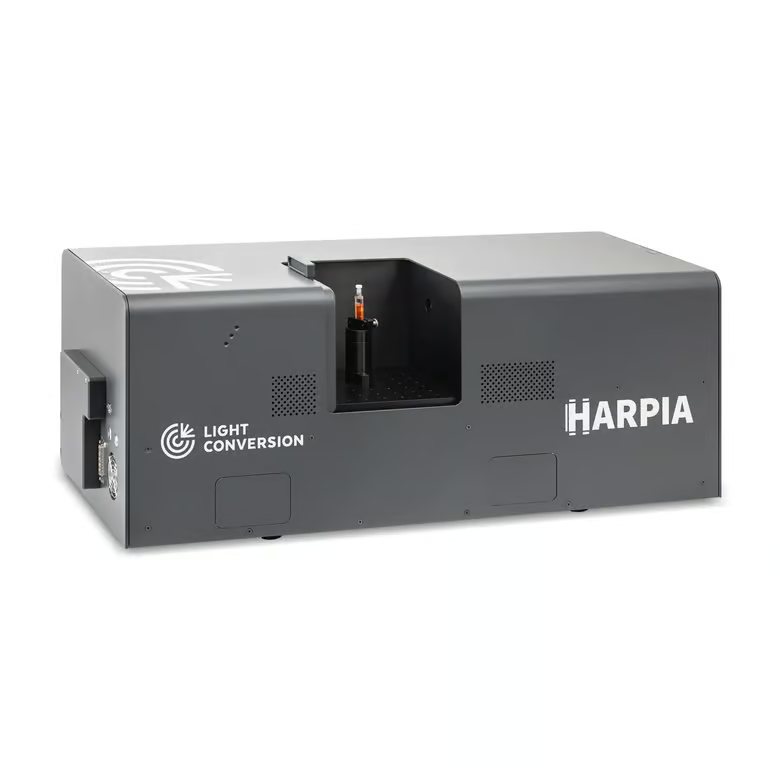
Transient absorption spectroscopy is a pump–probe technique used to measure time-dependent changes in the absorption of an optically excited sample. By tracking these changes, the technique provides quantitative information about processes such as electron and proton transfer, solvation, vibrational relaxation, exciton energy transfer, and photoreaction dynamics in molecular systems, semiconductors, and advanced materials. HARPIA spectroscopy systems combine ultrafast laser sources, wavelength-tunable excitation, a transient absorption spectrometer, and integrated data acquisition in a compact platform.
How it works
Transient absorption spectroscopy measures how the optical absorption of a sample changes following photoexcitation. Fluorescence-based methods can only see emissive excited states. Measuring the change in absorption also reveals intermediate transients and non-emissive states in both the ground and excited states. A narrowband pump pulse initiates a photophysical or photochemical process. A temporally delayed broadband probe then records the change in transmittance versus probe wavelength and delay, producing a two-dimensional map of the dynamics. Temporal resolution is set mainly by the pulse duration and the synchronization of the two beams; modern ultrafast lasers reach tens of femtoseconds.
Advanced measurement modes
On HARPIA-TA, transient absorption can be extended with additional modes. Transient reflection monitors pump-induced changes in reflectivity rather than transmission, which is useful for opaque materials, thin films, and semiconductor structures. Pump intensity-resolved measurements vary the excitation intensity to expose annihilation and saturation. Polarization-resolved measurements use linear or circular pump and probe states to study molecular orientation, aggregation, energy-transfer pathways, and chirality-dependent responses.
Typical setup
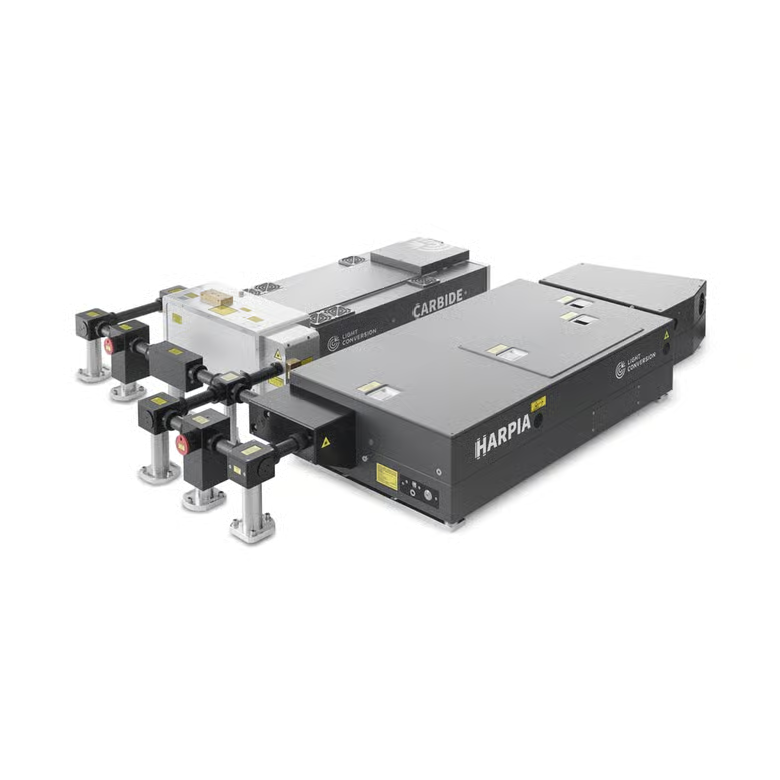
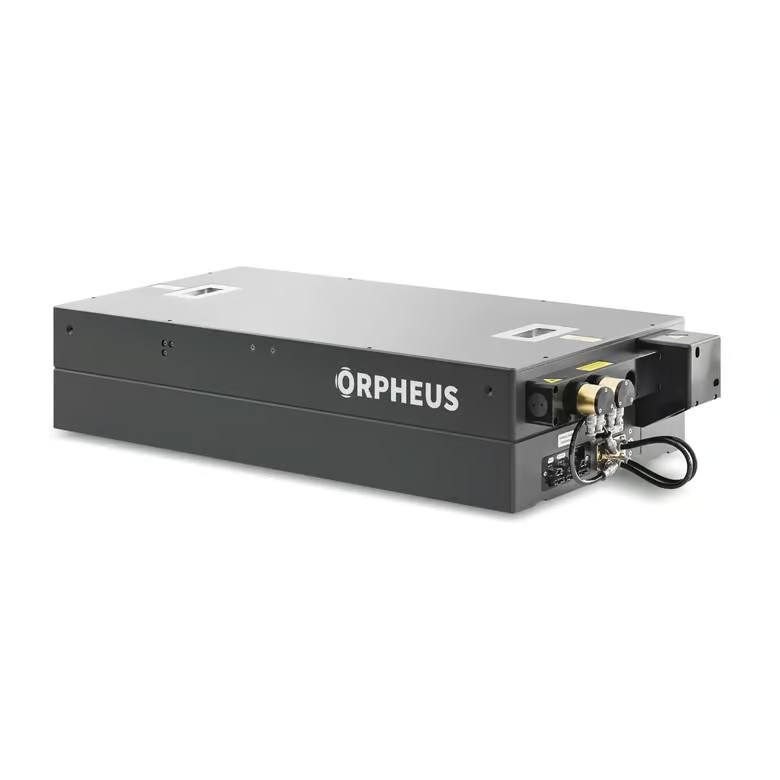
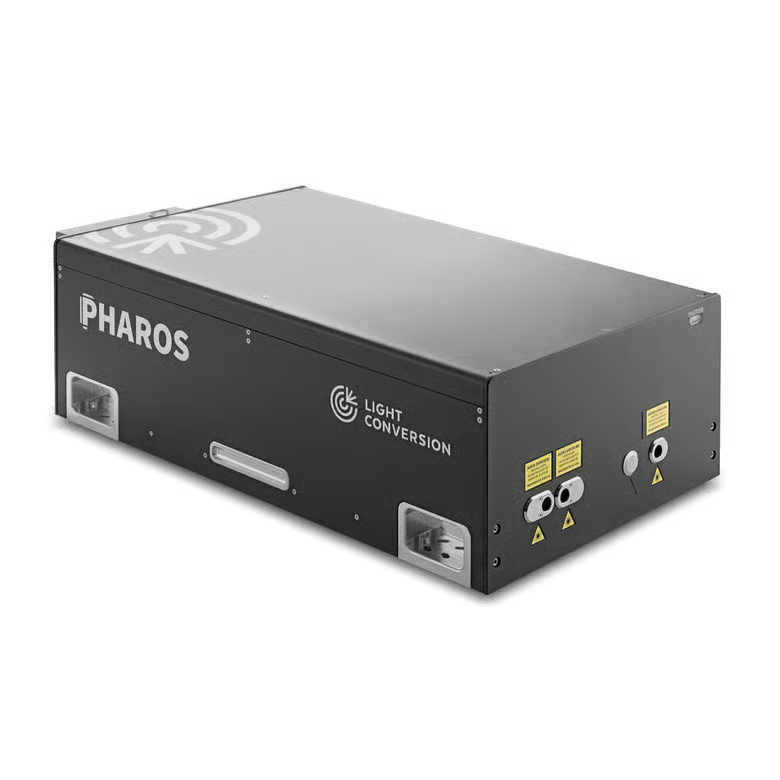
A typical setup has three elements: an ultrafast laser, a wavelength-tunable source, and a transient absorption spectrometer. The laser supplies the femtosecond pulses. Tunable excitation is usually generated in an optical parametric amplifier, so a chosen electronic or vibrational transition can be addressed. The spectrometer synchronizes pump and probe, sets the delay, and records the absorption change. HARPIA systems keep optical paths short and stable, and switch measurement modes in the same software. They pair with CARBIDE or PHAROS lasers and ORPHEUS or I-OPA tunable sources. HARPIA-LIGHT integrates the femtosecond laser and the spectrometer in a single-box Class 1 product for laboratories that need a compact tabletop system.
HARPIA-TA
HARPIA-TA provides transient absorption on the HARPIA platform. The high repetition rate of CARBIDE and PHAROS lasers lets the measurement run at pulse energies down to several nanojoules, which reduces unwanted nonlinear effects and sample degradation. Broadband probes cover UV to near-IR; a second OPA and a single-wavelength detector extend the range into the mid-IR up to 13 µm. The optical delay line reaches 8 ns. Pump polarization and intensity, sample position, and supercontinuum switching are automated, and the instrument can move between transient absorption and transient reflection. Spectral dynamics of β-carotene in solution. Measurement conditions: 100 kHz, 490 nm pump, < 10 nJ pump pulse energy, 13 s per spectrum (per delay point).
Infrared pump–probe on GaAs
Pump–probe dynamics of a GaAs wafer in the IR, recorded with the signal and reference single-channel detectors of HARPIA-TA. Measurement conditions: 75 kHz, 700 nm pump, 1 s per point.
HARPIA-TB third beam
The HARPIA-TB module adds a temporally delayed pulse to the pump–probe sequence for multi-pulse transient absorption: perturbing ongoing photodynamics, reaching higher excited states, or steering a photochemical path. It also enables femtosecond stimulated Raman scattering when frequency-narrowed picosecond pulses are delivered. Polarization is set with a Berek compensator, intensity with a variable neutral-density filter, and the delay line reaches 4 ns. FSRS dynamics of neoxanthin on HARPIA-TA with HARPIA-TB. Measurement conditions: 25 kHz, 440 nm actinic pump at 200 nJ, 530 nm Raman pump at 300 nJ.
Pump–dump–probe
Pump–dump–probe dynamics of DCM laser dye, with the dump pulse resonant to the emission band. Measurement conditions: 50 kHz, 515 nm pump, 700 nm dump, 21 ps dump delay, 90 nJ pump, 190 nJ dump.
HARPIA-TF fluorescence
The HARPIA-TF module adds Kerr gating, fluorescence upconversion, and time-correlated single-photon counting. Kerr gating records the full fluorescence spectrum at each delay with femtosecond resolution. Upconversion mixes the emission with a gate pulse in a nonlinear crystal. TCSPC builds a decay histogram from single-photon arrival times, typically with tens to hundreds of picoseconds of resolution, and can also follow phosphorescence. Kerr-gate measurements in DCM show fluorescence evolution with sub-picosecond resolution.
Kerr gate on β-carotene
Kerr-gate measurements in β-carotene show the resolution of the method. The S₂→S₀ fluorescence of carotenoids is ultrafast (< 100 fs), so the recorded data are mainly instrument-response limited.
Fluorescence upconversion
Fluorescence dynamics of DCM laser dye in solution, recorded with HARPIA-TF in fluorescence upconversion mode. Measurement conditions: 100 kHz, 430 nm pump.
TCSPC
Fluorescence dynamics of DCM laser dye in solution, recorded with HARPIA-TF in TCSPC mode. Measurement conditions: 100 kHz, 430 nm pump.
HARPIA-TA-FP flash photolysis
The HARPIA-TA-FP module measures long-lived states on nanosecond-to-millisecond delays by replacing the mechanically delayed femtosecond probe with an electronically triggered broadband nanosecond probe. Nanosecond spectral dynamics of meso-tetraphenylporphine in solution. Measurement conditions: 1.8 kHz, 343 nm pump, 5.4 μJ pump energy.
HARPIA-LIGHT
HARPIA-LIGHT integrates a femtosecond laser and a transient absorption spectrometer in a single-box Class 1 product. Spectral dynamics of DCM laser dye in solution. Measurement conditions: 60 kHz, 343 nm pump, 3 s per spectrum (per delay point).
Long-pass filter dynamics
Ultrafast dynamics of a long-pass filter measured on HARPIA-LIGHT. Measurement conditions: 60 kHz, 343 nm pump, 70 nJ pump energy, 1 s per spectrum (per delay point); 200 ms per spectrum, 60 min total.
Where it is used
Transient absorption spectroscopy is widely used on molecular systems, semiconductors, and biological complexes. In photochemistry and photobiology it follows energy transfer, charge separation, photosynthetic processes, and reaction intermediates. In semiconductor research it reports charge-carrier generation, transport, trapping, and recombination. In materials science it is applied to photovoltaic materials, photocatalysts, quantum materials, and other photoactive systems. Because it observes both emissive and non-emissive states over a broad temporal range, it remains one of the most versatile methods for ultrafast optical and electronic dynamics.