Laser source development
Carrier-envelope phase stabilization
Carrier-envelope phase determines the accuracy of high-energy and attosecond science experiments, and spectroscopy measurements, thus requires significant attention.
Introduction
What CEP is
The electric field of a laser pulse can be described as a sinusoidal oscillation, called the carrier, multiplied by a slowly varying envelope function. When the pulse propagates through a medium, the relative position between the carrier wave and the envelope may change due to chromatic dispersion and optical nonlinearities, causing a difference between phase velocity and group velocity. The carrier-envelope phase (CEP) is defined as the difference between the optical phase of the carrier wave and the envelope position. The CEP determines the accuracy of high-energy and attosecond experiments and ultrafast spectroscopy measurements. The carrier-envelope offset (CEO) is defined as the CEP difference from pulse to pulse.
CEP in the time domain
Carrier-envelope phase (CEP) in the time domain.
How it is locked
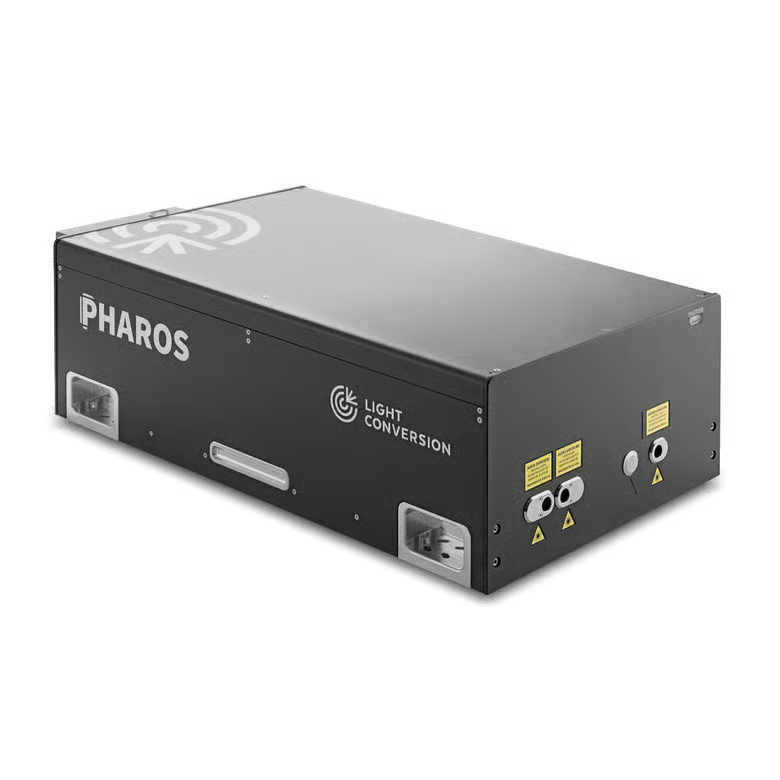
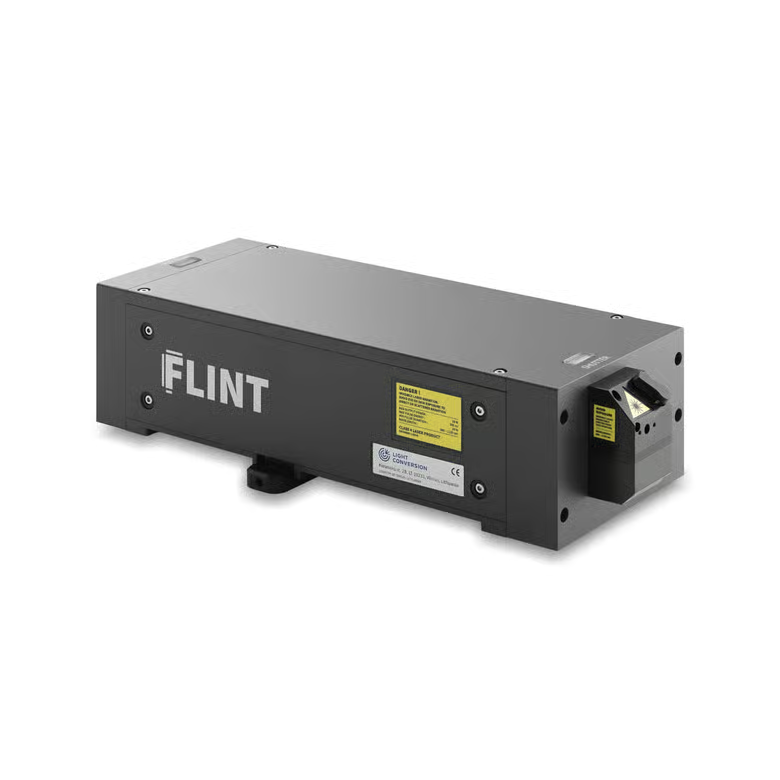
PHAROS lasers and FLINT oscillators can be equipped with feedback electronics for CEP stabilization of the output pulses. The CEO of the oscillators is actively locked to 1/4th of the repetition rate with a standard deviation of less than 100 mrad. The CEP drift occurring inside the amplifier and the user setup can be compensated with an out-of-loop f–2f interferometer, which is a part of the complete PHAROS active CEP stabilization package. CEP stabilization can also be achieved in complex OPCPA systems.
PHAROS long-term CEP stability
PHAROS long-term CEP stability at 200 kHz.
FLINT oscillator phase noise
CEP-locked FLINT oscillator phase noise data.