Nonlinear and extreme light generation
High harmonic generation
One of the most sophisticated and intriguing applications of high-energy femtosecond pulses is the process of high harmonic generation.
Introduction
What is high harmonic generation?
One of the most sophisticated and intriguing applications of high-energy femtosecond pulses is the process of high harmonic generation. By focusing intense laser pulses into a gas target, one can generate much higher-order harmonics than what is possible with conventional solid-state nonlinear materials, extending well into the extreme ultraviolet (EUV) or even soft X-ray range. At the same time, thanks to the broad bandwidth and short wavelength, the resulting pulses may even reach the attosecond scale.
Three-step model
In general, the high harmonic generation process can be described with a simplified semi-classical three-step model. First, an intense laser field temporally suppresses the Coulomb potential of an atom. Then, an electronic wave packet can tunnel into the continuum and is accelerated by the driving laser field. When the driving laser field reverses, the electronic wave packet is pulled back to the atomic core to interfere with the residual bound electronic wave packet in the ground state of the system. The interference results in a burst of coherent photons with photon energies from tens to thousands of electronvolts (eV). Since this process is repeated every half-cycle of the laser field, interference between consecutive pulses results in odd high-order harmonics of the fundamental frequency and, in the time domain, an attosecond pulse train.
Intensities and repetition rate
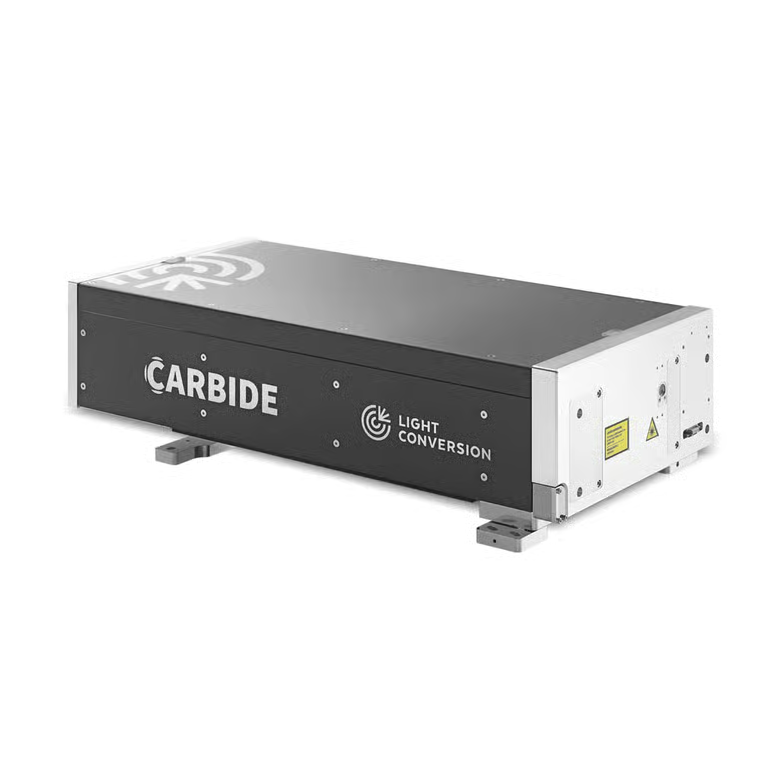
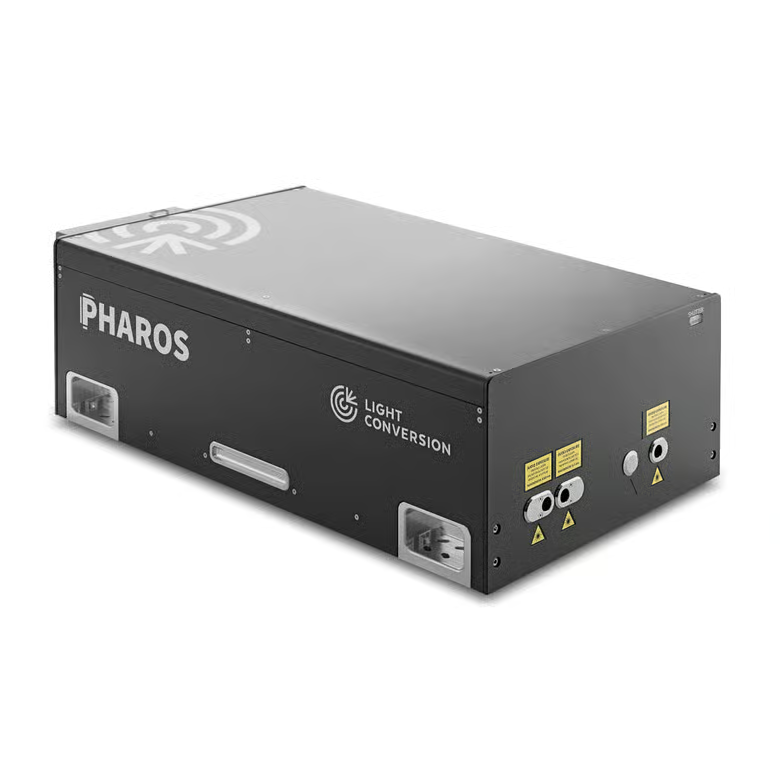
High harmonic generation typically requires laser intensities on the order of 10¹⁴ W/cm² to distort the Coulomb potential, allowing the electron to tunnel out and get accelerated to high energies. Such fields are usually obtained by high-peak-power systems, such as optical parametric chirped-pulse amplification (OPCPA) systems. However, high harmonic generation has also been demonstrated using direct fundamental radiation from CARBIDE and PHAROS femtosecond lasers. Yb-based laser sources are of high interest because of their high repetition rates. Traditionally, high harmonic generation has been limited to low pulse repetition rates, not exceeding a few kilohertz. Many scientific applications using high harmonic generation could benefit from higher repetition rates. For example, time-resolved photoemission spectroscopy is limited in the number of emitted photoelectrons per pulse by charge effects, and therefore the statistics can be improved only by operating at higher repetition rates. The generation of high harmonics at 100 kHz has been reported using the PHAROS femtosecond laser and focusing its radiation in both gas-chamber and capillary geometries.
Tabletop EUV
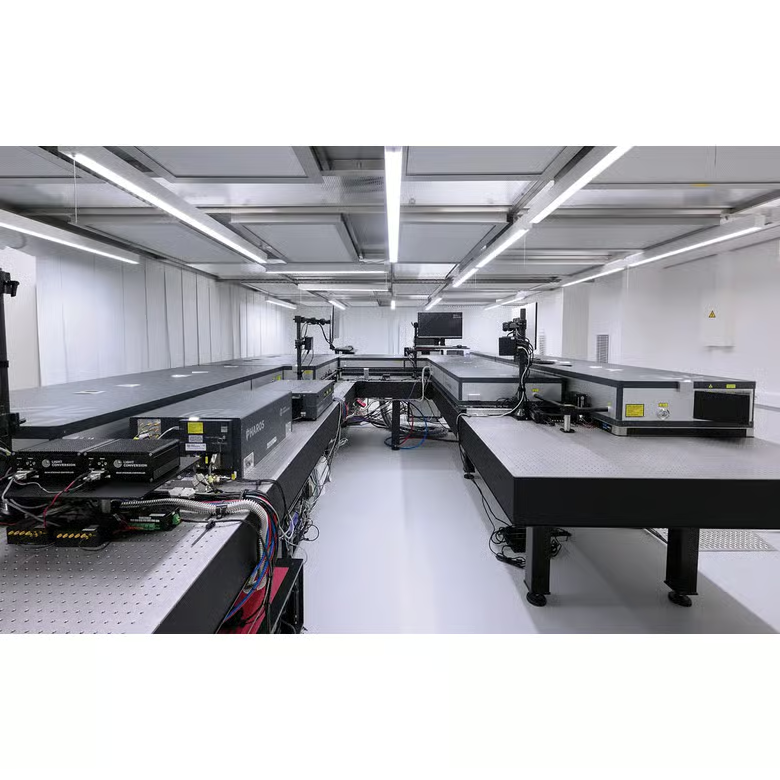
Tabletop solutions for the generation of ultrafast, high-repetition-rate, and coherent EUV light enable experiments previously possible only at large-scale synchrotron facilities. Compact laser systems improve the availability, reliability, and stability of high harmonic generation sources.