Ultrafast spectroscopy
Transient grating spectroscopy
Laser-induced transient grating spectroscopy is a pump–probe technique that utilizes laser interference instead of a single beam to excite the medium.
Introduction
What is transient grating spectroscopy?
Light-induced transient grating (LITG), also called laser-induced transient grating spectroscopy, is a non-destructive, contactless method for charge-carrier recombination and diffusion. It follows a pump–probe idea, but two coherent pumps interfere on the sample at a chosen angle. The interference pattern writes a periodic distribution of non-equilibrium carriers, which modulates the refractive index and forms a transient diffraction grating. A delayed probe is diffracted or reflected from that grating. Decay versus grating period yields carrier lifetime and diffusion coefficient, and from those the diffusion length and ambipolar mobility.
Pulse duration and materials
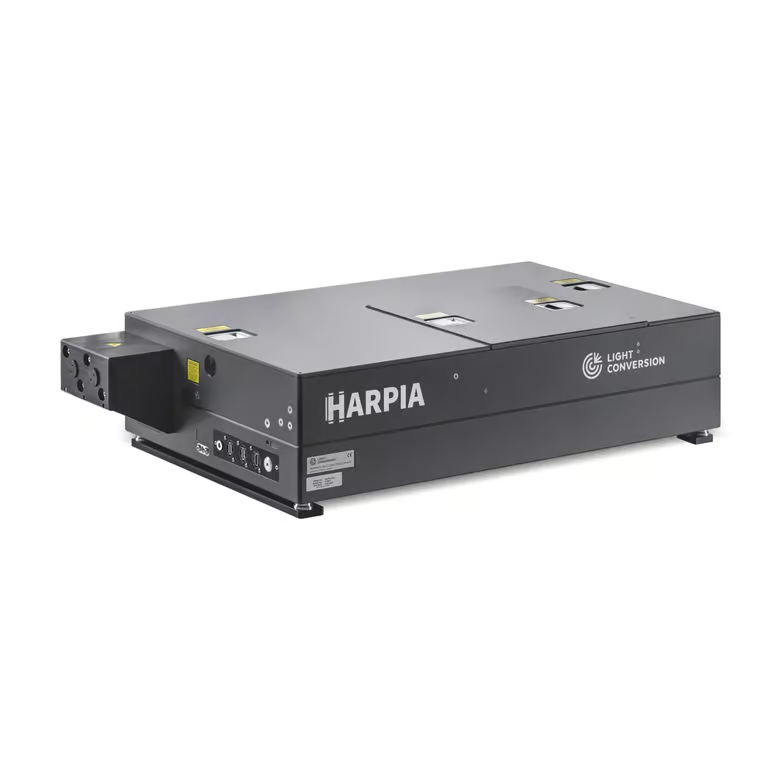
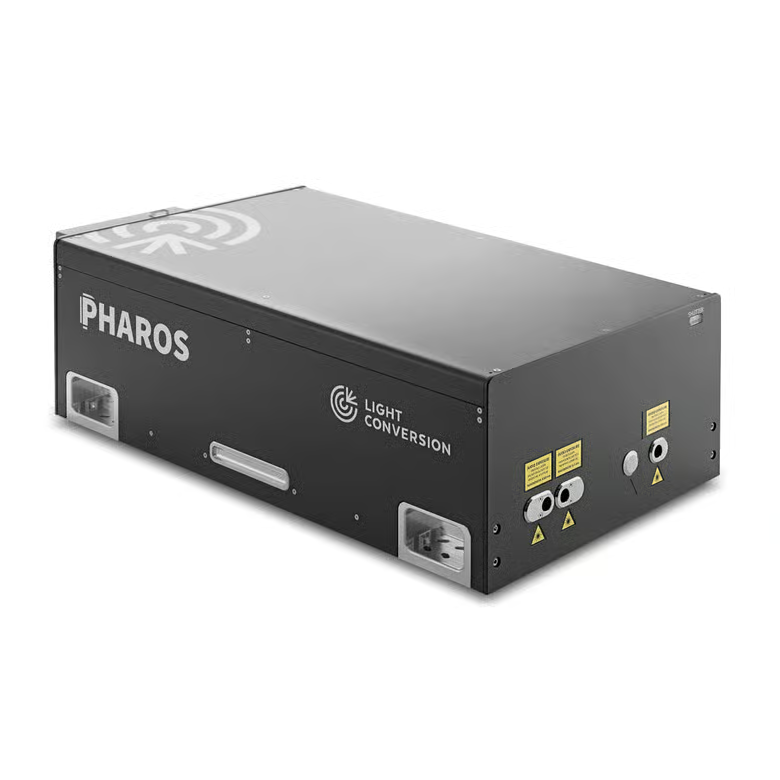
Femtosecond pulses give the temporal resolution needed for electronic excitations, vibrational dynamics, and carrier thermalization. Nanosecond pulses are better for slower thermal diffusion or acoustic waves. LITG has been used on polar and non-polar InGaN/GaN quantum wells, Zn-alloyed CsPbI₃ perovskite films, CdSeₓTe₁₋ₓ heterostructures, and TMD/graphene stacks such as WSe₂. Delays up to 8 ns are available on HARPIA-TG with a CARBIDE or PHAROS laser and an integrated I-OPA. The compact system is automated and can characterize electrically non-conductive or non-fluorescent samples, including SiC, GaN, perovskites, organic and inorganic solar cells, quantum dots, and quantum wells.
Principle of a LITG measurement
Two pump beams write the grating; a delayed probe reads the diffracted or reflected signal.