Ultrafast spectroscopy
Sum-frequency generation spectroscopy
Sum-frequency generation spectroscopy is used to assess the vibrational properties of surfaces and interfaces with monolayer sensitivity.
Introduction
What is SFG spectroscopy?
Sum-frequency generation (SFG) spectroscopy assesses the vibrational properties of surfaces and interfaces with monolayer sensitivity. Unlike Raman spectroscopy, which is sensitive to the bulk, SFG reports the physical and chemical properties of molecular layers where inversion symmetry is broken.
How it works
A mid-infrared beam and a visible beam overlap on the surface or interface. Polarization and intensity of the sum-frequency signal give dipole orientation and the surface vibrational spectrum. SFG is a second-order nonlinear process allowed only when inversion symmetry is broken, so it is specifically surface-sensitive. High spectral resolution, and therefore a clear vibrational fingerprint, requires one of the pulses to have a sufficiently narrow bandwidth.
Spectral windows
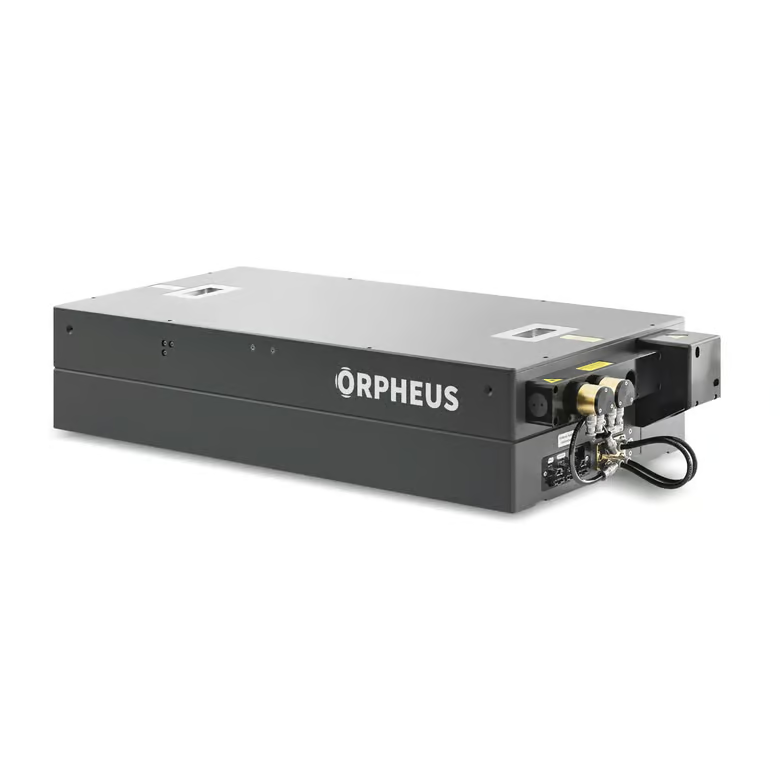
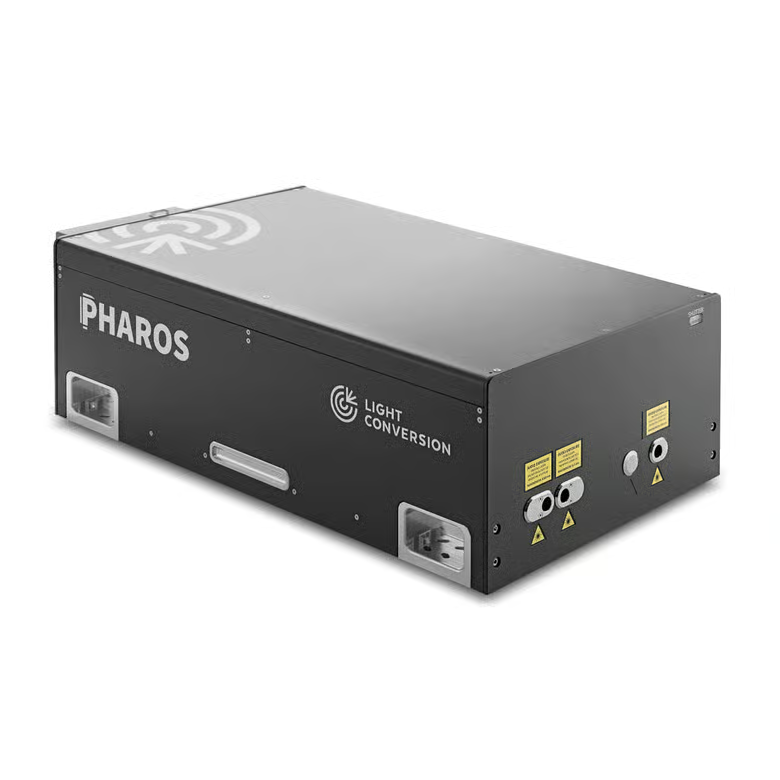
A main scientific target is interfacial water: OH stretching of normal water and OD stretching of heavy water at 2.6–3.5 µm and 3.5–4.5 µm. Other ranges of interest are 4.5–5.5 µm (metal carbonyls and nitriles) and 5.5–6.5 µm (interfacial biomolecules). Longer mid-infrared wavelengths reach lower-frequency biomolecular vibrations. Broadband mid-infrared sources such as ORPHEUS-MIR, pumped by CARBIDE or PHAROS, cover those windows and address many vibrational levels at once. An SHBC doubles the laser frequency and narrows the bandwidth. In that configuration the SFG signal falls in the visible, so complex infrared detection is not required.