Ultrafast spectroscopy
Two-dimensional electronic spectroscopy
An ultrafast laser spectroscopy technique studying electronic states in condensed-phase systems.
Introduction
What is 2DES?
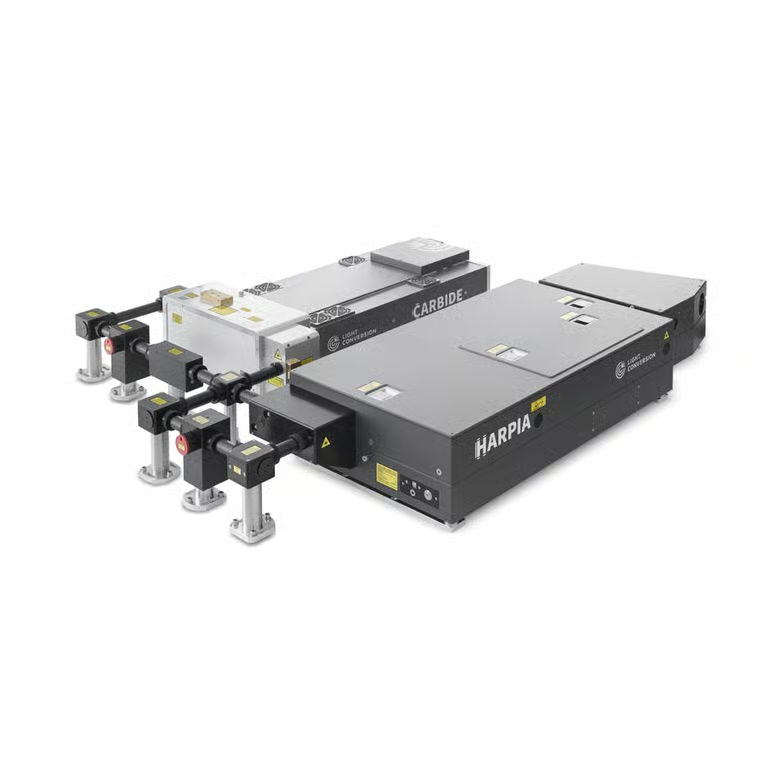
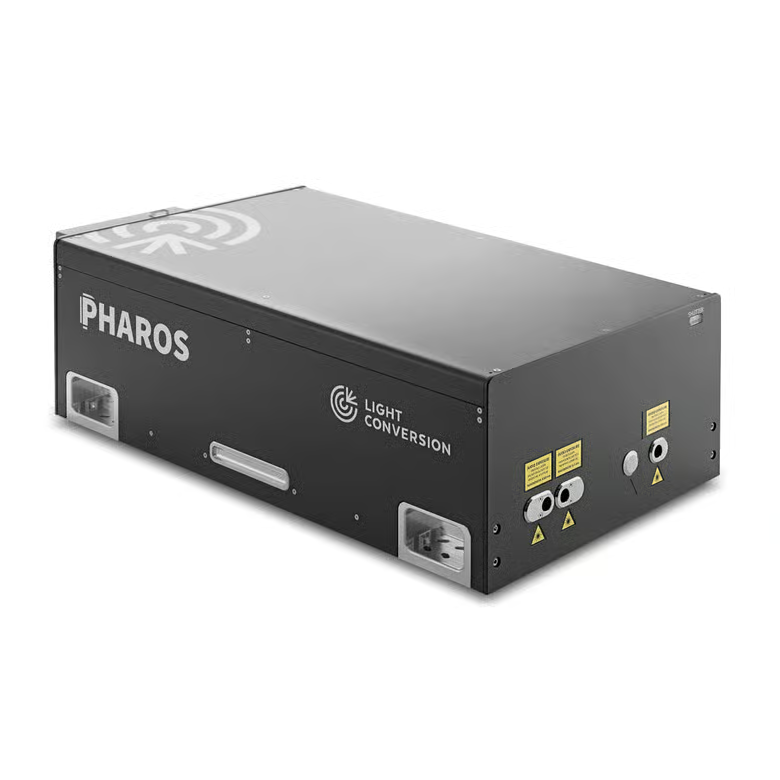
Two-dimensional electronic spectroscopy (2DES) is an ultrafast technique for condensed-phase systems. “Electronic” means optical frequencies in the visible are used to excite electronic energy states. The experiment records the signal emitted after a sequence of three laser pulses, typically a few hundred femtoseconds long, from a CARBIDE or PHAROS laser. The main result is a two-dimensional absorption spectrum that correlates excitation and detection frequencies.
Why use two frequency axes
As summarized by Gelžinis et al., 2D spectroscopy uncouples time resolution from excitation-frequency resolution, so a chosen state can be followed with selective excitation and excellent time resolution; background-free detection gives a strong signal-to-noise ratio; and one run covers a wide range of excitation frequencies, whereas pump–probe needs many separate measurements. For the last fifteen years 2D spectroscopy has contributed heavily to excitation dynamics in photosynthetic molecular complexes. The same idea in the infrared is two-dimensional infrared spectroscopy (2DIR).