Ultrafast spectroscopy
Time- and angle-resolved photoemission spectroscopy
TR-ARPES extends and complements conventional ARPES by adding femtosecond time resolution.
Introduction
What is ARPES?
Angle-resolved photoemission spectroscopy (ARPES) analyzes the electronic band structure in momentum and energy space for superconductors, topological insulators, transition-metal dichalcogenides, and other crystalline materials. A deep-UV beam hits the surface. Electrons emitted above the vacuum level by the photoelectric effect are collected and scanned around the sample. Their energy and momentum give a complete band-structure map.
What TR-ARPES adds
Time- and angle-resolved photoemission spectroscopy (TR-ARPES) extends conventional ARPES with femtosecond temporal resolution. It resolves elementary scattering processes directly in the band structure as a function of energy and electron momentum, because spectral and dynamic information are recorded together. In the pump–probe scheme a femtosecond infrared pulse excites the sample by electron–hole pair creation, and a delayed UV pulse probes the momentum and energy of electrons in the conduction band.
Laser requirements
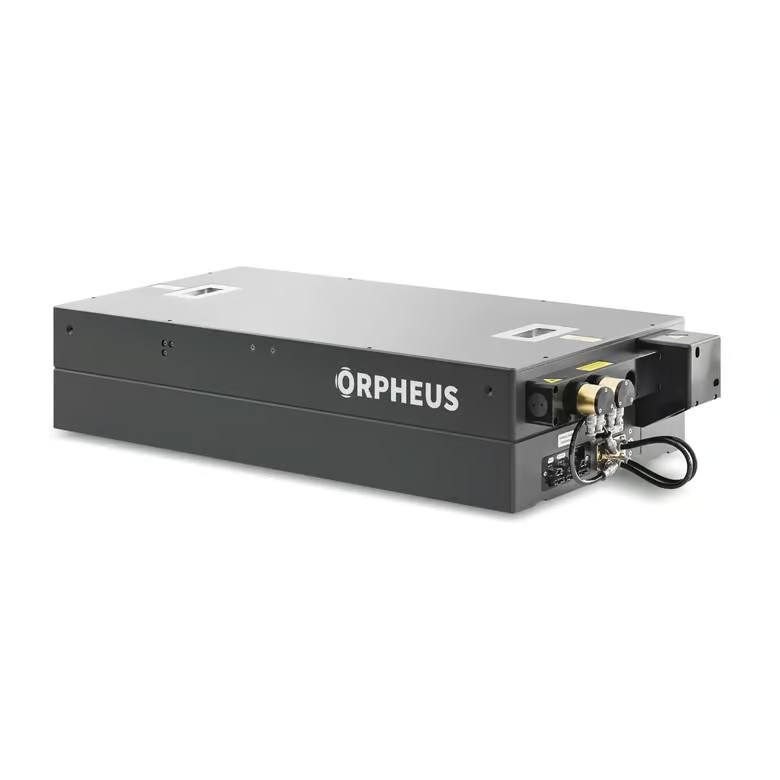
The ideal source produces deep-UV photons at a high repetition rate (hundreds of kilohertz or higher). Intermediate pulse energy is preferred, because high pulse energies cause parasitic space-charge effects at the surface. The UV photon is typically generated by high-harmonic generation in solids or gases. Optical parametric amplifiers such as ORPHEUS-MIR and ORPHEUS-N, and optical parametric chirped-pulse amplifiers, are used as the pump and probe sources for these experiments.