Ultrafast spectroscopy
Time-resolved fluorescence spectroscopy
Fluorescence upconversion, TCSPC, and phosphorescence allow for measuring fluorescence dynamics at different time scales.
Introduction
What is time-resolved fluorescence?
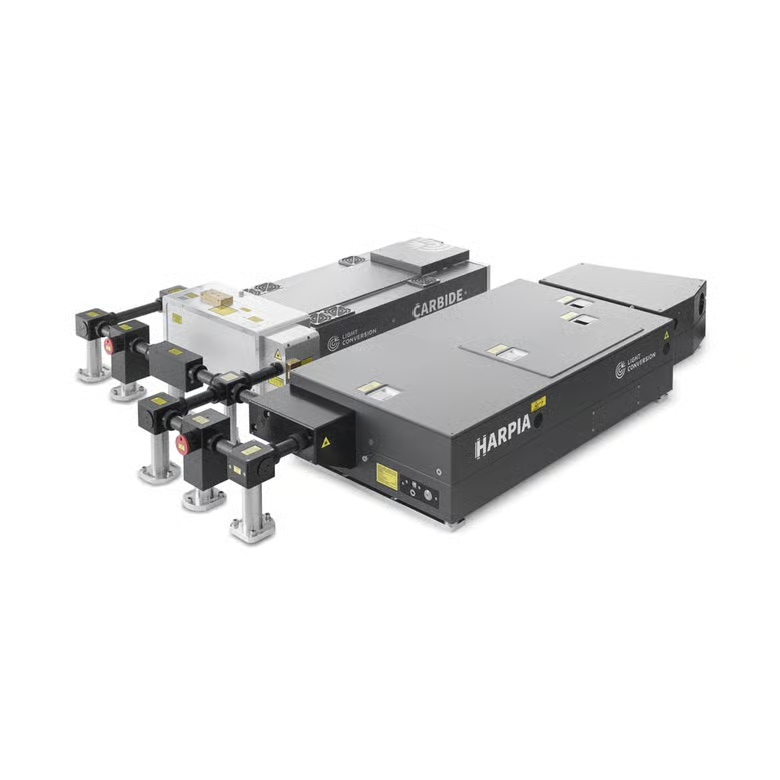
Time-resolved fluorescence spectroscopy investigates molecular processes in the excited state after optical excitation. By watching how fluorescence emission evolves, the measurement reports relaxation pathways, energy and charge transfer, and molecular interactions that a steady-state spectrum cannot give. HARPIA systems with the HARPIA-TF module combine ultrafast excitation with complementary fluorescence detection for different temporal windows.
Kerr gate
The optical Kerr gate enables femtosecond time-resolved fluorescence through optical gating. Fluorescence is polarized and sent through a Kerr medium between a polarizer and a crossed analyzer. A synchronized gate pulse induces a short birefringence, opening a window of a few hundred femtoseconds. The full fluorescence spectrum is acquired at each delay. Principle of Kerr-gate spectroscopy.
Kerr-gate measurement
Kerr-gate measurements in DCM illustrate fluorescence evolution with sub-picosecond temporal resolution.
Fluorescence upconversion
Fluorescence upconversion is used for the fastest emission. Fluorescence is combined with a synchronized gate pulse in a nonlinear crystal. The sum-frequency intensity follows the temporal overlap of the two fields, so scanning the gate delay reconstructs the decay with femtosecond resolution. Principle of time-resolved fluorescence upconversion.
Upconversion measurement
Fluorescence dynamics of DCM laser dye in solution, recorded with HARPIA-TF in fluorescence upconversion mode. Measurement conditions: 100 kHz, 430 nm pump.
Time-correlated single-photon counting
TCSPC is an electronic time-domain method. Each excitation pulse starts a clock; the first fluorescence photon stops it. Repeating the cycle builds a histogram of photon arrival times, i.e. the decay. Resolution is typically tens to hundreds of picoseconds, set by the detector, but the sensitivity is high and phosphorescence can be recorded as well. Principle of TCSPC.
TCSPC measurement
Fluorescence dynamics of DCM laser dye in solution, recorded with HARPIA-TF in TCSPC mode. Measurement conditions: 100 kHz, 430 nm pump.
Where it is used
Time-resolved fluorescence is used in photochemistry for excited-state relaxation, electron and proton transfer, and photoreaction dynamics; in photobiology for protein conformational change, photosynthetic energy transfer, and probe–biomolecule interactions; and in materials science for exciton migration, aggregation, and charge transfer, including work on organic photovoltaic materials.