Micro- and nanofabrication
Photopolymerization
Laser-induced photopolymerization, also known as direct laser lithography or direct laser writing, is a technique for the formation of 3D nanostructures in photosensitive resins.
Introduction
What is photopolymerization?
Photopolymerization is an additive manufacturing process used to fabricate 3D micro- and nanostructures by selectively solidifying photosensitive materials using light. Combined with tightly focused femtosecond laser pulses, the technique enables direct fabrication of structures with submicron feature sizes, making it suitable for applications in photonics, micro-optics, microfluidics, and biomedical engineering. Recent advances in ultrafast laser technology continue to improve fabrication throughput, process stability, and the accessibility of high-resolution 3D microfabrication.
The chemical process
Photopolymerization is a light-induced chemical process in which liquid photosensitive materials are transformed into solid polymer structures. The process begins when several photons are absorbed by a photosensitive polymer molecule, bringing it to an excited state that ultimately forms a radical. The generated radical then participates in a chain polymerization reaction, leading to chemical cross-linking and solidification of the exposed material. The unexposed regions remain liquid and can subsequently be removed during development, leaving only the fabricated structure. Laser-induced photopolymerization occurs only within the laser focus. This highly localized interaction provides precise spatial control over the fabrication process and enables true 3D structuring inside photosensitive materials.
What is direct laser lithography?
Direct laser lithography (DLL), also referred to as direct laser writing (DLW), is a fabrication technique based on localized photopolymerization initiated by a tightly focused laser beam. DLL writes structures directly inside a photosensitive material by scanning the laser focus along a predefined 3D trajectory. When ultrashort femtosecond laser pulses are employed, photopolymerization is typically initiated through multiphoton absorption. Because nonlinear absorption occurs only at the focal volume where the photon density is sufficiently high, polymerization remains confined to a small 3D volume known as a voxel. By translating this voxel throughout the material, complex free-form micro- and nanostructures can be fabricated directly without the need for masks or multiple processing steps.
How the process is written
The fabrication process begins by focusing femtosecond laser pulses into a photosensitive material. The laser focus is positioned at the desired location within the resin, where nonlinear absorption deposits energy only inside the focal volume. This localized exposure initiates polymerization within a single voxel while leaving the surrounding material unaffected. Successive movement of the laser focus throughout the material produces overlapping voxels that form continuous polymer structures. After laser exposure, the sample is developed by removing the unpolymerized material, leaving the fabricated 3D structure.
Photopolymerization mechanism
Photopolymerization is initiated when photons are absorbed by molecules within the photosensitive material, promoting them to an excited electronic state. In conventional photoresists, this excitation generates reactive radicals through photoinitiator molecules, which subsequently initiate chain polymerization. The resulting cross-linked polymer network forms the solid structure that remains after development. The photochemical events leading to radical formation can follow a multitude of pathways involving different molecular states, and the resulting radical yield may differ accordingly. Two-photon, three-photon, and higher-order absorption coefficients may also differ strongly and exhibit different wavelength dependencies because different molecular states follow different selection rules. Localized photopolymerization has also been demonstrated without photoinitiators, indicating that the underlying photo-excitation mechanisms may vary depending on the photosensitive system.
Multiphoton absorption
Multiphoton photopolymerization is commonly initiated through two-photon absorption in so-called threshold materials. However, the number of photons simultaneously absorbed to excite a molecule from the ground state depends on both the absorption spectrum of the photoresist and the excitation wavelength. When the excitation wavelength coincides with the absorption peak of the material, polymerization proceeds through one-photon absorption. If the excitation wavelength is approximately twice the absorption wavelength, two-photon absorption can be induced, while three-photon absorption is expected when the excitation wavelength is approximately three times longer. Ultrashort pulses are sensitive to the group delay dispersion introduced by the optical system, which can stretch the pulse in time and reduce its peak intensity. Since this decreases the efficiency of multiphoton processes, the dispersion of the optical system must be compensated by introducing an opposite temporal pre-chirp before the laser beam reaches the sample.
Formation of three-dimensional structures
Because polymerization remains confined to the focal volume, the laser focus can be translated throughout the material to fabricate arbitrary 3D geometries. Individual voxels are positioned sequentially to form continuous structures, while layer-by-layer scanning enables the fabrication of objects ranging from tens of micrometres to several millimetres in size with submicron feature resolution. The dimensions of each fabricated voxel depend on the laser intensity, pulse duration, wavelength, numerical aperture of the focusing optics, repetition rate, translation velocity, and material properties.
Advantages of direct laser lithography
Direct laser lithography enables the fabrication of 3D geometries that are difficult or impossible to produce using conventional manufacturing techniques. Owing to the localized nature of multiphoton absorption, polymerization remains confined to the laser focal volume, enabling feature sizes down to approximately 100 nm while producing functional structures with dimensions ranging from tens of micrometres to several millimetres. Direct laser lithography also allows structures to be written directly from computer-aided design (CAD) models. This enables rapid prototyping and design flexibility while eliminating the need for dedicated tooling.
Photopolymerization materials
Photosensitive materials used for direct laser lithography differ in their optical, chemical, and mechanical properties. Conventional photoresists are primarily based on acrylic and epoxy resins. Epoxy polymers exhibit low shrinkage and high structural stability, whereas acrylates generally provide higher photosensitivity, lower critical energy, lower viscosity, and controllable mechanical properties. In addition to conventional petroleum-derived photoresists, increasing attention has been devoted to photopolymers obtained from renewable resources. Vegetable oils have emerged as attractive polymer precursors; among these, soybean oil and acrylated epoxidized soybean oil (AESO) are widely used. Although AESO-based photopolymers offer a sustainable alternative, their long aliphatic chains result in relatively soft polymer networks, so aromatic comonomers — including plant-derived vanillin dimethacrylate and vanillin diacrylate — are commonly added to improve mechanical properties.
Where it is used
In photonics and micro-optics, direct laser lithography is used to fabricate photonic crystals, diffractive optical elements, microlenses, and other optical components requiring complex free-form geometries and submicron features. The technique is also employed for metamaterials and plasmonic structures. The ability to fabricate enclosed channels and assembly-free movable components has established it for microfluidics and micromechanics. In biomedical engineering, it is widely used to fabricate scaffolds for tissue engineering, biomimetic structures, microneedle arrays, and other biomedical devices.
Lasers for photopolymerization
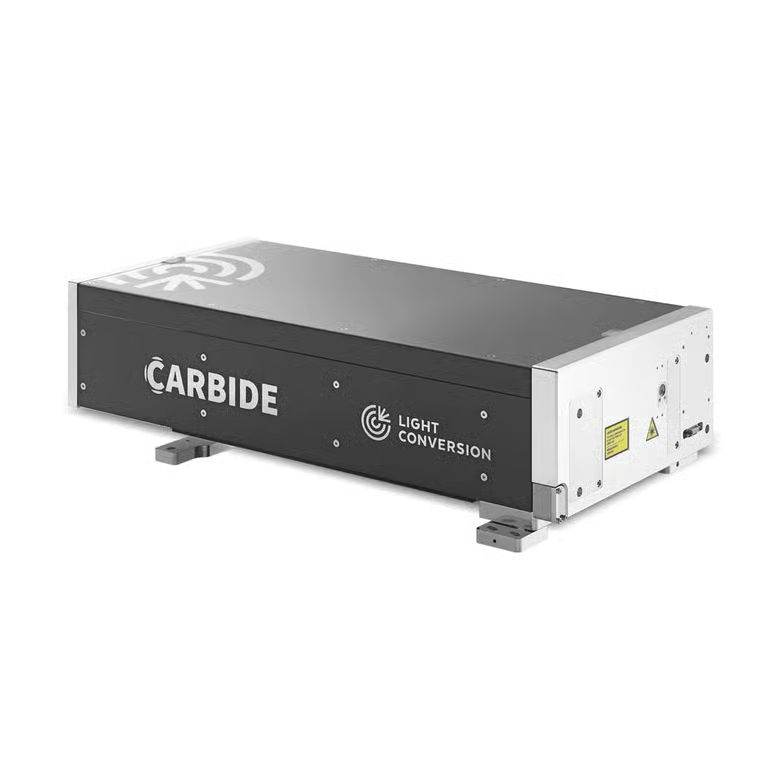
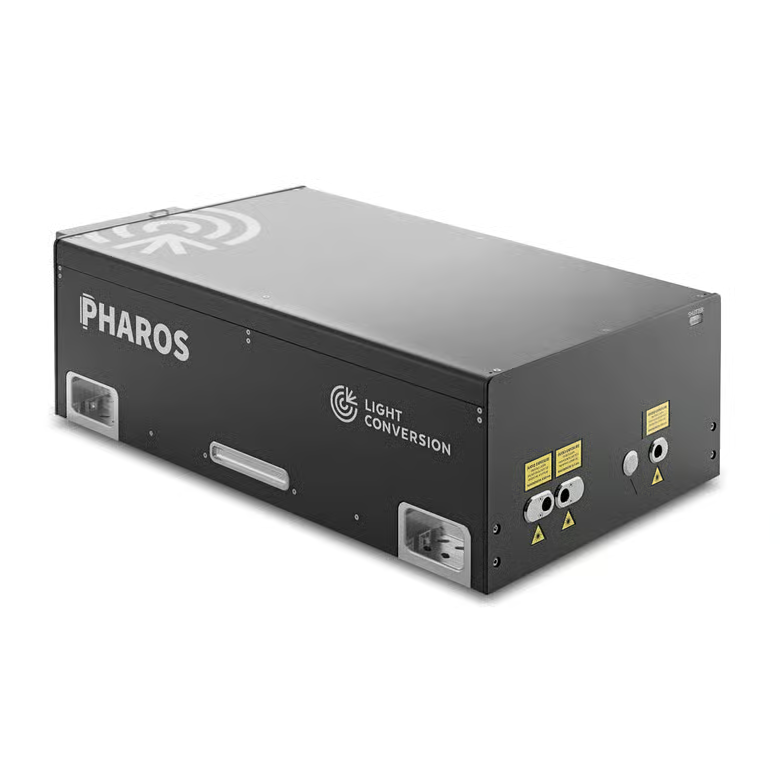
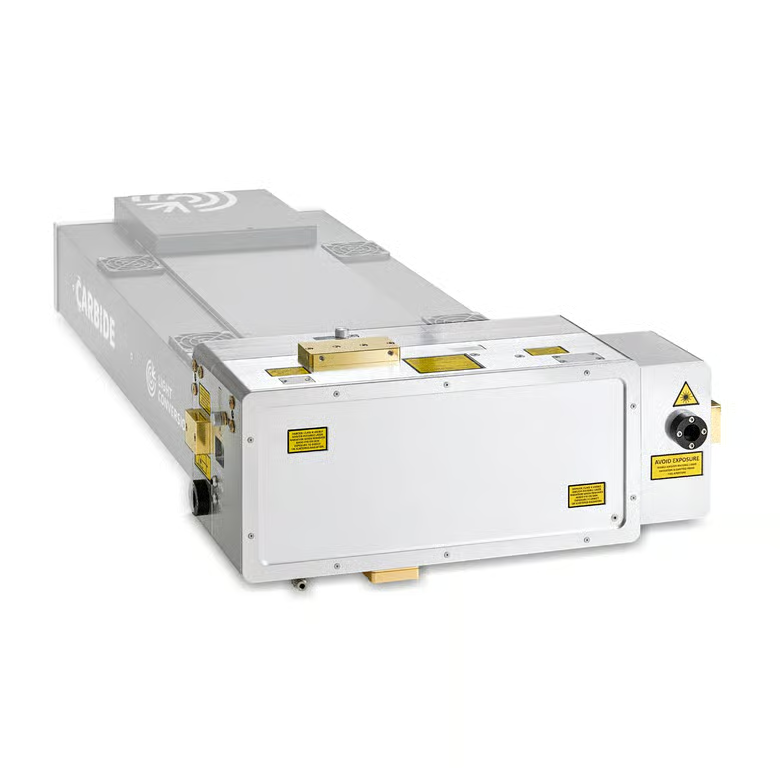
Direct laser lithography requires laser systems capable of delivering stable ultrashort pulses with excellent beam quality and precisely controlled pulse parameters. CARBIDE and PHAROS femtosecond lasers provide the high peak and average powers and ultrashort pulse durations required. Their fundamental wavelength at 1030 nm, together with harmonic generation at 515 nm and 343 nm, supports photopolymerization across a wide range of commercially available photoresists. For applications requiring additional wavelength flexibility, the industrial-grade I-OPA optical parametric amplifier, integrated with the laser platform, extends the accessible spectral range beyond the fixed harmonics so the excitation wavelength can be matched to the absorption characteristics of different photosensitive materials.