Advanced microscopy
Ultrafast electron microscopy
Ultrafast electron microscopy is a pump-probe technique in which an ultrafast laser pulse excites the material, and a delayed electron pulse detects the response.
Introduction
Why add a pulsed laser to TEM?
Transmission electron microscopy (TEM) is one of the most powerful imaging techniques, enabling imaging of three-dimensional (3D) structures at the atomic scale. However, the temporal resolution of TEM is often limited by the recording rate of the imaging device. Thus, to overcome such a limit, a pulsed laser source is applied to trigger the photoemission and, subsequently, to obtain a higher temporal resolution.
What UEM measures
Ultrafast electron microscopy (UEM or UTEM) is, essentially, a pump–probe technique where an ultrafast laser pump pulse excites the material and a delayed probe electron pulse detects the response at a specific time correlated with the pump pulse. Accordingly, the temporal resolution is no longer limited by the speed of the electron detector, as it is determined by both the pump laser pulse duration and the probe electron pulse. Therefore, the generation of short electron pulses is also quite important and is often carried out using a second or third harmonic of the fundamental frequency of the same ultrafast laser. Furthermore, UEM requires laser output with a high pulse repetition rate and high output stability to preserve a high signal-to-noise ratio (SNR).
Lasers used
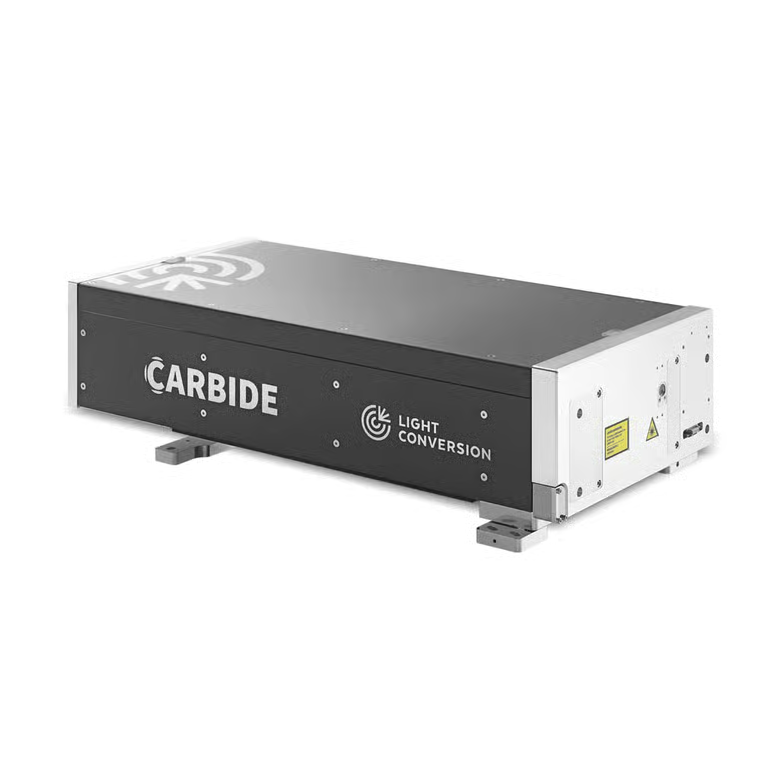
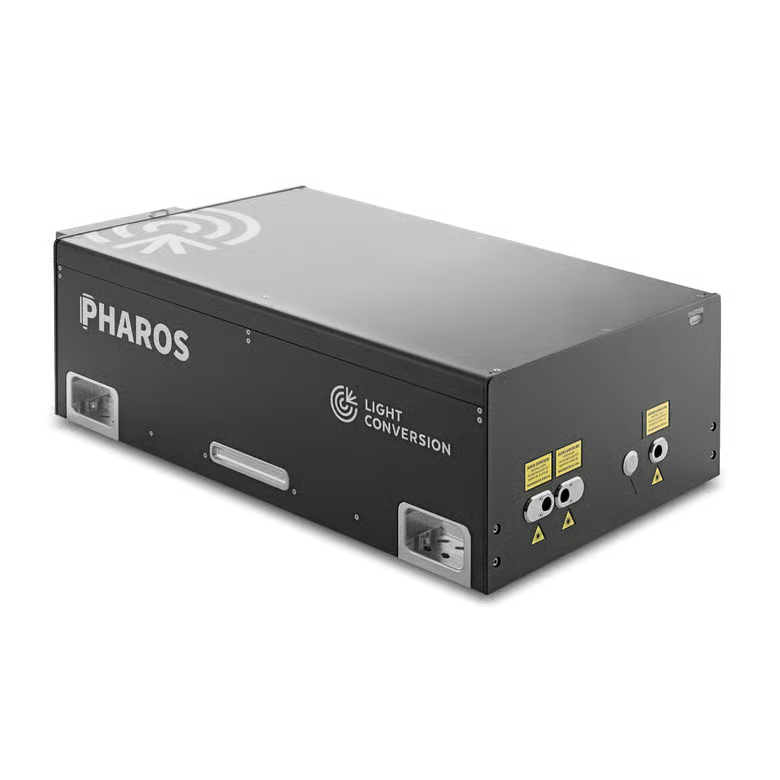
CARBIDE and PHAROS lasers with femtosecond pulse duration, high repetition rate, and high output stability are used as sources for ultrafast electron microscopy.